Many matting decisions are inherited. Sticky cleanroom entrance mats were at the gowning-room door at commissioning, so they are reordered every month. That habit deserves a fresh look when a site reviews its contamination control strategy or adds trolley routes.
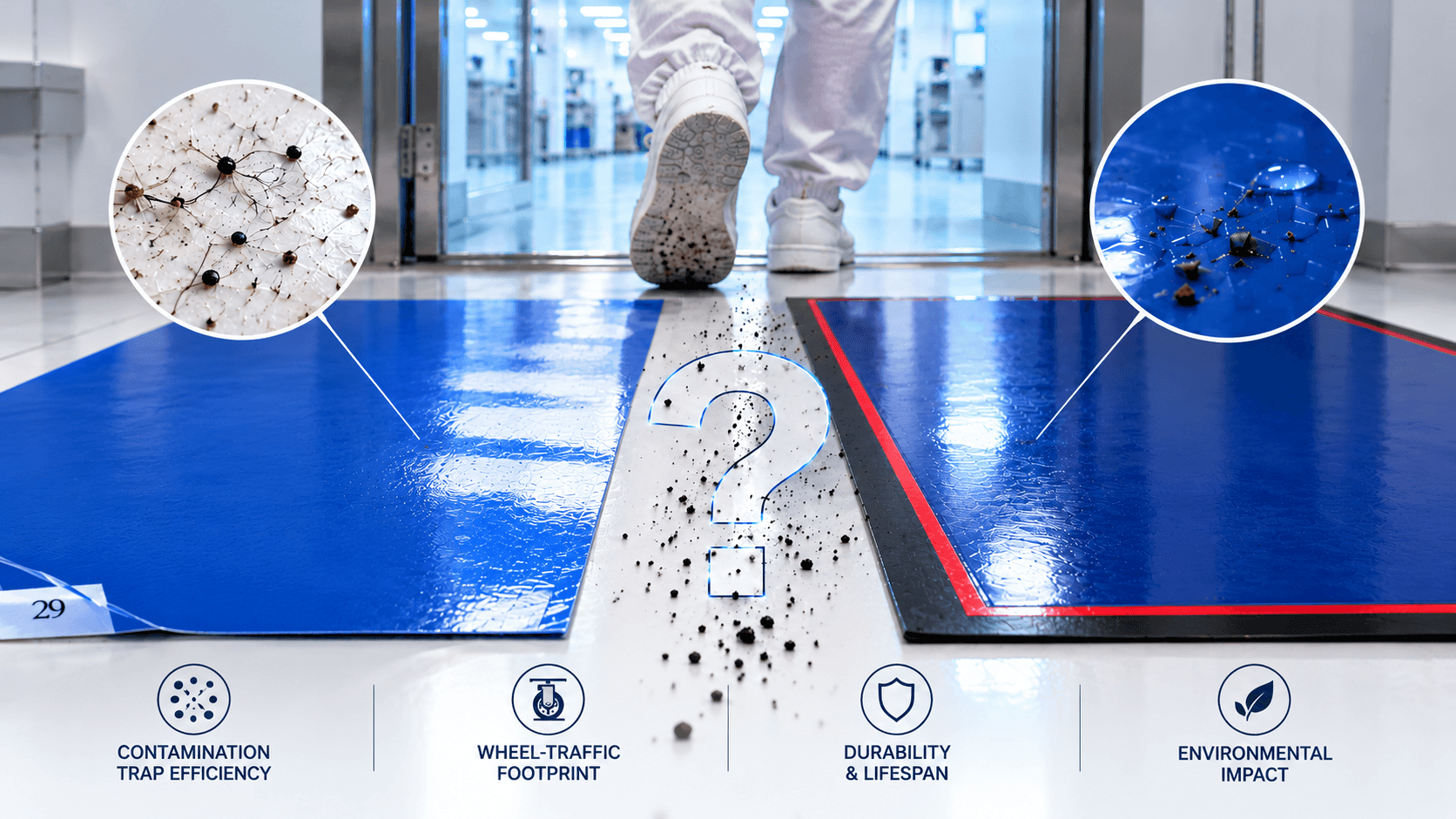
This guide compares peel-off sticky mats with washable contamination control mats on four buyer questions: capture, footprint, durability and environmental impact.
Sticky Mats vs Polymeric Cleanroom Mats at a Glance
1. Capture Mechanism
Sticky Mats: Adhesive film captures particles on contact.
Polymeric Mats: Polymer surface retains particles, which are removed during cleaning.
2. Performance Over Time
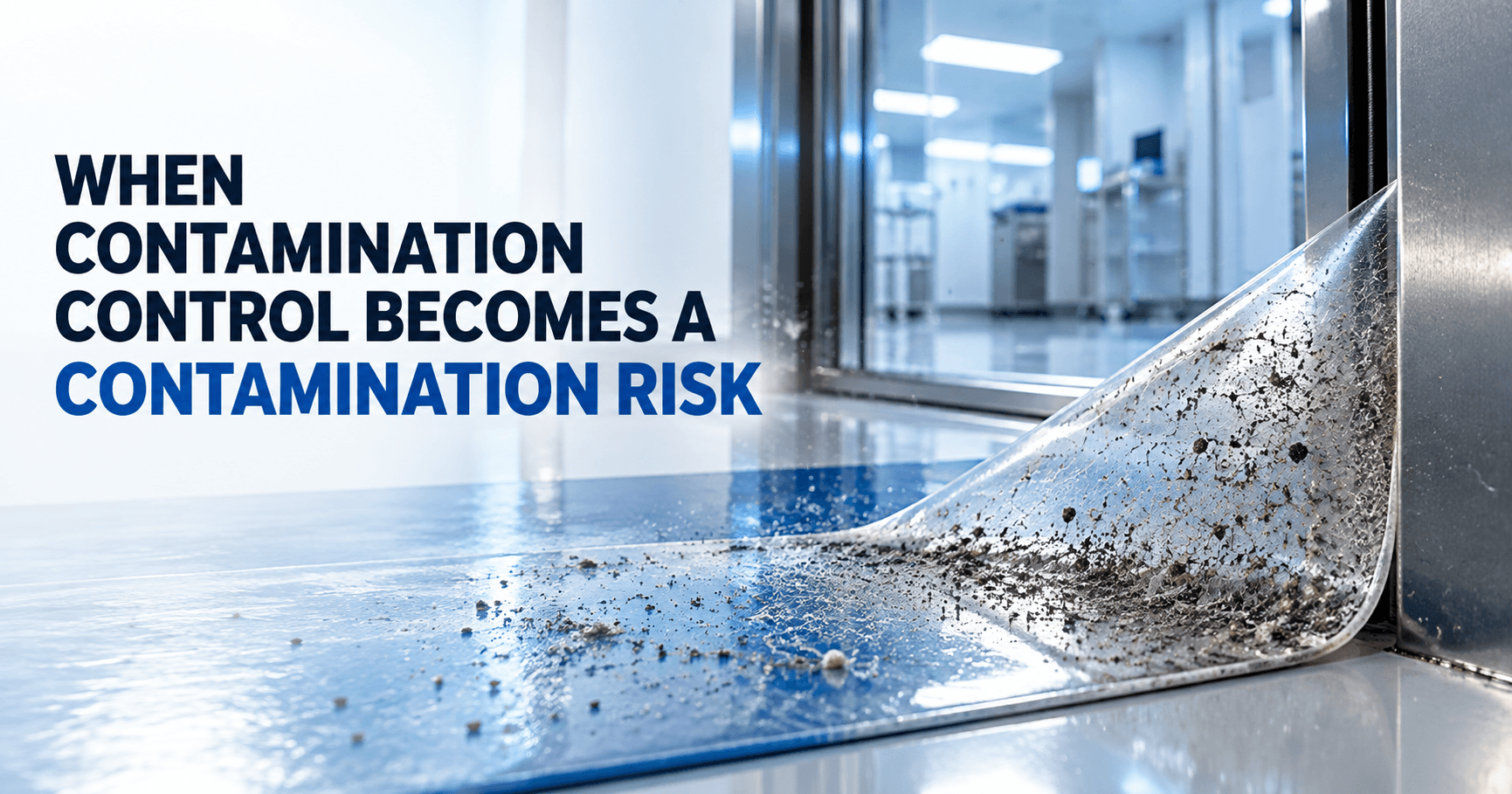
Sticky Mats: Adhesion decreases as particles accumulate; requires timely sheet removal.
Polymeric Mats: Cleaned and reused according to a defined cleaning SOP.
3. Footprint
Sticky Mats: Fixed sizes, typically allowing one or two steps per foot.
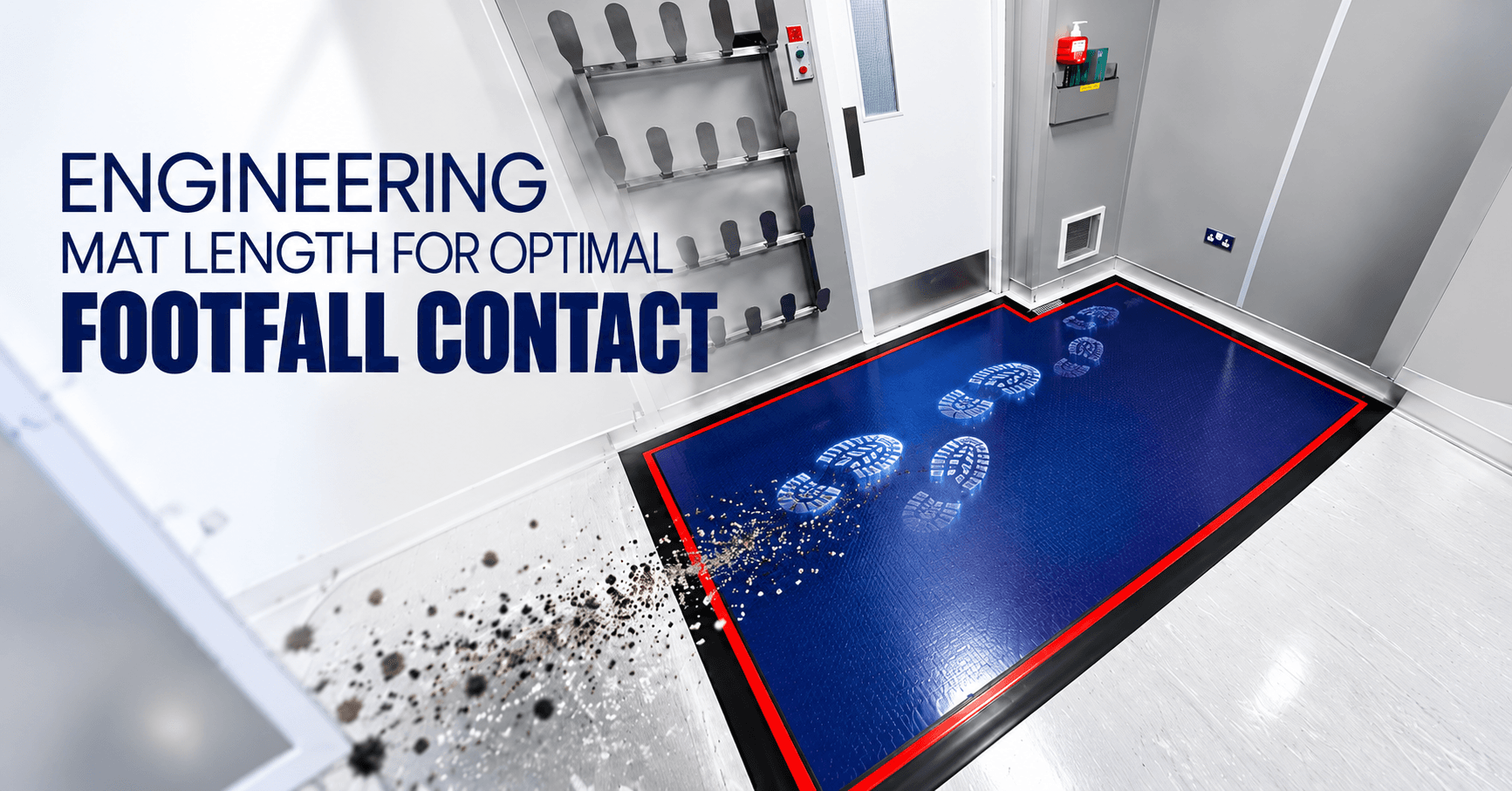
Polymeric Mats: CC Matting is 2.0 m wide and can be cut to the required length.
4. Wheel Traffic
Sticky Mats: Limited wheel rotations; adhesive sheets may lift or tear.
Polymeric Mats: Can accommodate multiple wheel rotations; load resistance of 130 kg/cm².
5. Service Life
Sticky Mats: Single-use sheets require regular peeling and disposal.
Polymeric Mats: 3–5 year service life with a 2-year warranty.
6. Waste Generation
Sticky Mats: Continuous waste from discarded adhesive-coated sheets.
Polymeric Mats: Reusable throughout service life, with recycling recommended at end of life.
Trap Efficiency: Contact Count Matters More Than Stickiness
A mat only removes contamination that touches it. Real-world efficiency depends on how well the surface captures particles and how many full contacts each sole or wheel makes.
With an adult stride of roughly 70 cm, a short sticky mat often receives one contact per foot. Adhesion also declines as the top sheet loads, so performance depends on staff peeling at the right interval, a manual step performed over the loaded surface.
What the polymeric matting evidence shows
In an independent CPC Laboratories study (February 2026), contaminated rubber-soled shoes took three steps on a CC Matting polymeric mat. Average removal was 91.8% of particles >5 µm, 100% of particles >100 µm and 92.0% of fibres >100 µm. Results apply to the method tested, so site particle monitoring remains the real test.
Footprint and Wheel Traffic: Sizing Washable Cleanroom Mats
Footwear contamination control is only half the picture. A trolley wheel only cleans the part of its circumference that rolls across the mat, and rear wheels arrive last.
A 125 mm wheel has a circumference of about 39 cm. For a trolley with an 80 cm wheelbase, a practical rule is mat length ≥ wheelbase + two wheel circumferences, roughly 1.6 m.
In the same study, plastic trolley wheels rolled across 90 cm of polymeric mat showed average removal of 90.1% of particles >5 µm and 100% of particles and fibres >100 µm. Because CC Matting polymeric matting is 2.0 m wide and cut to length, it can run wall-to-wall at a transition, behaving more like contamination control flooring than a doormat.
Durability: The Reusable Cleanroom Matting Lifecycle
Reusable cleanroom matting shifts the control from replacement frequency to cleaning frequency. The cleaning SOP becomes the critical document, with its interval justified by particle data. The MSDS advises avoiding acetones and abrasive agents.
What to check behind ISO Class 5 mats claims
A mat can shed contamination as well as remove it. For CC Matting polymeric matting, the Quality & Efficacy Manual documents:
• Particle emission: Fraunhofer IPA qualification as suitable for ISO Class 5 (ISO 14644-1) under tribological stress.
• Outgassing: ASTM E595 (modified, 50 °C) TML 0.29%, CVCM 0.08%.
• Static control: surface resistivity in the static-dissipative range.
• Slip resistance: pendulum values of 65 dry and 57 wet, low slip risk.
• Antimicrobial: Biomaster additive, tested to ISO 22196.
Environmental Impact: Sticky Mat Waste vs Contamination Control Polymeric Matting
Every peeled sheet is contaminated, adhesive-coated film destined for landfill or incineration. Count annual sheet consumption across every doorway. A polymeric mat replaces that stream with one installed asset, and the MSDS recommends recycling at end of life.
Choosing a Sticky Mat Alternative
Sticky mats still suit temporary or low-traffic situations such as shutdowns and construction phases. A washable tacky mat alternative suits permanent transitions, trolley routes and busy doors, whether as pharmaceutical contamination control mats at a Grade C airlock or healthcare contamination control mats at an aseptic pharmacy.
EU GMP Annex 1 expects a documented Contamination Control Strategy but does not prescribe a mat type. Record the rationale, placement, cleaning and monitoring. No mat, on its own, guarantees compliance.
Frequently Asked Questions
Are washable cleanroom mats as effective as sticky mats?
Effectiveness depends on surface capture and contact count. Washable polymeric mats can be installed longer, increasing contacts. In independent testing, CC Matting polymeric matting removed over 90% of particles >5 µm from shoe soles and trolley wheels.
How long should a cleanroom mat be for trolley traffic?
Long enough for every wheel to rotate fully at least twice on it: the wheelbase plus two wheel circumferences. An 80 cm wheelbase with 125 mm wheels needs roughly 1.6 m.
How often should polymeric contamination control mats be cleaned?
There is no universal interval. Set a starting frequency from traffic volume and the adjacent room grade, then adjust it using particle monitoring data.
Does EU GMP Annex 1 require contamination control mats?
No. Annex 1 requires a Contamination Control Strategy covering all contamination sources, including personnel and material flow. Matting can be one justified, monitored control within it.
Can polymeric matting be used in ESD-sensitive areas?
CC Matting polymeric matting tested in the static-dissipative surface resistivity range. Confirm compatibility with your site’s ESD programme and grounding requirements before installation.
Next Step
Review the specification for reusable contamination control matting, the test reports on the compliance page, or portable cleanroom mats for temporary areas. Ask any contamination control mat supplier for the report behind each claim. CC Matting installs in Ireland and the UK and works with a contamination control mat distributor network worldwide; contact the team to discuss sizing.